
You’re driving to work with a colleague mindful of the other cars and pedestrians. Suddenly, you’re broad-sided by a speeding car that came our of nowhere…or, stopped at a red light, you are unexpectedly rear-ended by a SUV.
You hit the steering wheel, and your passenger hits the windshield.
Everyone’s first instinct when a motor vehicle accident happens is to ask, “Are you all right?” You check for obvious injuries: Is anyone unconscious? Can you move your arms and legs? Are you or your passenger bleeding?
When no one appears injured, you breathe a sigh of relief: Everyone’s okay.
But sometimes everyone is not okay. You or your passenger may have suffered a traumatic brain injury (TBI) that is not obvious, and immediate treatment may make a difference.
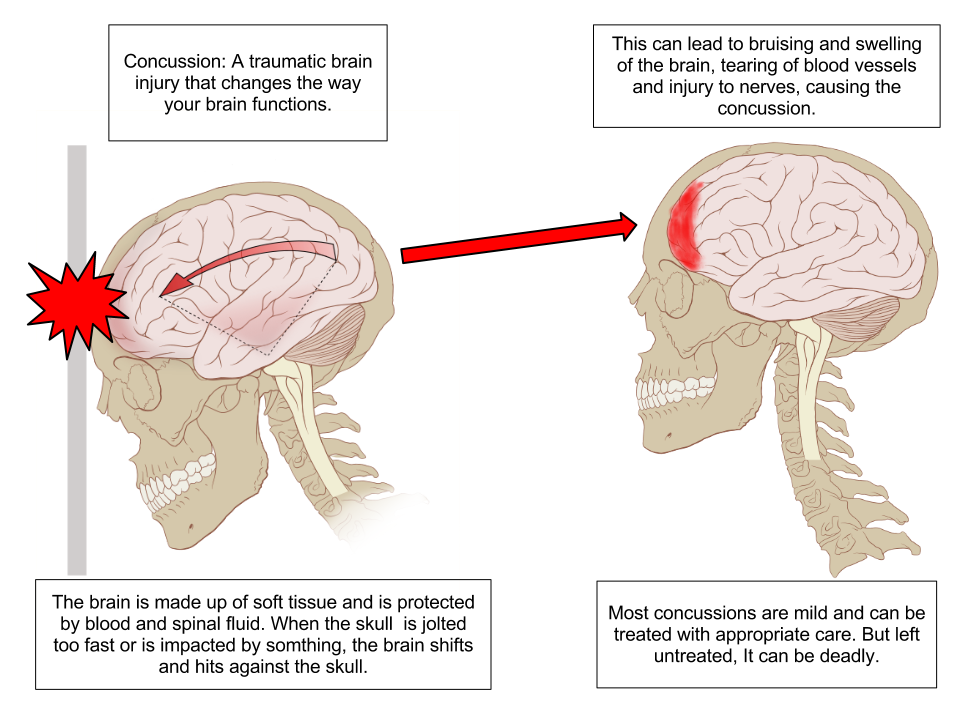
In a concussion, the brain is shaken or jostled, but there is no structural injury that can be seen on an X-ray, CT scan or MRI. Yet, after a concussion, the brain isn’t working the way it was prior to the injury. Concussion changes the way a person thinks, acts, sees and functions. An examination by a physician should be performed to evaluate any changes in balance, coordination, reflexes and vision.
You should get medical help immediately if you or anyone else in the accident:
- Becomes drowsy
- Behaves abnormally
- Has a stiff neck
- Develops a severe headache
- Loses consciousness – even briefly
- Vomits
According to the National Institute of Health, you require emergency treatment if you have any of the following symptoms:
- Loss of consciousness or drowsiness
- Convulsions
- Impaired hearing, smell, taste, or vision
- Clear or bloody fluid running from your nose, ears, or mouth
- Changes in size of your pupils
- Skull fracture or swelling, or scalp wound
- Facial fracture or bruising
- Inability to move arms or legs or lack of coordination
- Low blood pressure or rate of breathing
- Severe headache or stiff neck
- Slurred speech or blurred ision
- Vomiting
- Confusion or irritability
It is important to remember that the signs and symptoms of a concussion may not be immediate. Symptoms usually appear within 24 to 72 hours after the injury and can range from mild to severe, lasting for hours, days, weeks or even months.
This information is compliments of:
WASHINGTON MEDICAL
DR. ROBERT LABACZEWSKI AND DR. DOMINIC LAGANELLA
DR. JOHN ASHBY, PMR
EBENEZER OGUNTUASE, PT
TO CONTACT OUR OFFICE,
CALL (856) 582-8041 (SEWELL) OR
(856) 205-1422 (VINELAND)
WWW.WASHINGTONMEDICALPA.COM
ON SITE PHYSICAL THERAPY AND EMG/NVC TESTING
 Back On The ROAD To Good Health